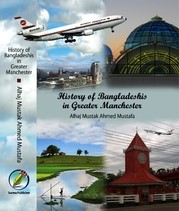
This is a translation version of the original video documentary which was than transcribed and translated from Bengali to English. A book with the title of History of Bangladeshis in Greater Manchester has been published and it will be distributed to the libraries, schools and universities. The interview took place in 2 December 2007, so information about his personal family information may have been changed.

8.31.1 Life in Bangladesh:
Alhaj Atar Miah Chowdhury was born in 1935, in the village of Gabdev, Nabigonj, Habigonj, Bangladesh. His father’s name is late Suruj Miah Chowdhury and his mother’s name is Khudija Bibi.
Mr. Chowdhury studied at the “Muraura Primary School”, than he went to “Gojonaipur Primary School” and then he studied in the local high school upto class nine.
Alhaj Atar Miah Chowdhury
All of the students used to go to school by foot; school was far away from home. He has one brother and one sister. After finishing his education he started a business in his village, the village people were very ordinary and the way of life was very simple. The people were dependent upon agriculture.
There was huge fish in the ponds, river, and the people used to catch the fish from the ponds and it was enough food for their family. Even in the market the fish was very cheap. The price for 37.5 kg of rice was 5-7 Takas. The price of everyday goods was available at very cheap prices also. The people were very happy and there were not many rich people in the village, there was no competition.
8.31.2 Journey to the UK & Immigration:
His nephew and cousin were in the UK and he had the information from them. There were some people from the village also who told him about the UK. He came to know that there were plenty of jobs available and people can earn and save money from this employment.

In 1962 he came to the UK, at that time he was only 27 years old. When he had the passport he made the journey in two weeks time. His nephew also came with him. His nephew was educated therefore he did not have any problem coming to the UK. He departed from Tejgaon Airport and flew by PIA.
He arrived in the Heathrow Airport; he then took a taxi from the Heathrow airport and went to a restaurant in London called the Karachi Restaurant. When he was coming from Heathrow airport to London he remembers seeing the road side and he has seen that there were no leaves on the trees and he thought all the trees were dead. Later on he came to know that due to the cold weather, all of the leaves had fallen down from the tree. The taxi fare was paid by the restaurant owner. The owner of the restaurant also arranged the transport to come to Manchester.
He went to the Euston train station and He paid £11.00 for the train fare. When he arrived at Manchester Piccadilly, It was in the morning. Mr. Chowdhury and his nephew went to the Bombay restaurant.
8.31.3 Life in the UK:
The house where he lived, there was a toilet outside the house and kitchen was in the cellar. The rent was £1 per seat, sharing the bed was 10 shilling. His cousin and his brother arranged the accommodation for him.
8.31.4 Employment:
After about a week his cousin and brother taken him to Nottingham to see a restaurant and introduce him to the owner. He started the job at the restaurant as a trainee waiter at the starting wages of £5 per week. Usually all the workers get free meals and accommodation. His cousin opened a restaurant in Blackburn known as the “Anglo Asia Restaurant”.
He left the other job and worked there as a kitchen porter. His cousin was encouraging him to become a chef, his cousin also told him that working as a chef is respectable and appreciated by many professionals. After working for about six month he was able to become a cook, he used to learn skills from the chef and observed other people even on his days off. For this learning effort he spent 72 hours working in the restaurant. He worked there for about 2 years.
His cousin sold his restaurant therefore the job had ended and he found a new job in the “Lucas Factory” in Burnley. He used to get £14 per week. There was a canteen facility but he used to take his meals to work with him. He used to work in the night shift (10pm – 5am), He worked there for a year.
He found another job in “Bayfield Cotton Mill” in Burnley. He would have the weekend off. He worked in the restaurant in the weekend and earned £5 for two nights. After that he joined a new factory where he worked there for about 12 years (1967 – 1981). That factory was very big, there was about 2,000 people working there in 3 shifts.
Following the closing of all the mills and factories he became unemployed and started to claim unemployed benefit. Mr. Chowdhury said although the wages were low in the restaurant work the food and accommodation was free which helped out a lot. If he wanted to become a chef he needed to work as a kitchen porter and if he wanted to become a waiter he needed to know how to make coffee.
There were some dishes such as chicken curry, meat curry, Bombay duck, Bombay chicken; there were some English dishes available at that time.
8.31.5 Housing:
During his employment at the factories the food and accommodation was his own responsibility. He used to share accommodation and food with other people. Most of the housing conditions were very poor, no inside toilets, no central heating or hot water facility and the kitchen was in the cellar. For heating the room people used the coal fire. It was so cold and the beds were not warm enough to go to sleep straight away, so it was very hard time for all the people.
On his day off, he used to go to the public bath because there were no bath facilities inside the house. There were 22 people living in one house. They would also get live chickens roaming around the house which would be used for food.
8.31.6 Social & Family:
He married in Bangladesh and his wife came to UK in 1970. He has 3 sons and 2 daughters. All the children have been educated and are working. He has many relatives living in Bangladesh therefore he has travelled there many times.

He was one of the supporters of the Bangladesh independence movement. He is a founding member of the Bangladesh Association & Community Project in Rochdale. He also served as a treasurer. Throughout the BACP they were able to establish a Bangla School in Rochdale.
In 1983 the Bangladeshi mosque was established. Prior to establishing this mosque, there was also a small mosque. The mosque was able to accommodate only 15-20 people. In the Sonali mosque the Bangladeshi and Pakistani used to pray Friday prayers together, but due to 1971 war, the Bangladeshi community felt unsecured to go to the same mosque. In the new mosque it is able to accommodate 1,000 people.
8.31.7 Conclusion:
Mr. Chowdhury became British citizenship but he still is very compassionate about Bangladesh. He is very happy to see his children have made progress in the UK. It may not have been possible to achieve all of these if he lived in Bangladesh. He thanked Allah for this. He is serving the community as a volunteer and helping the Bangladeshi community in Rochdale.