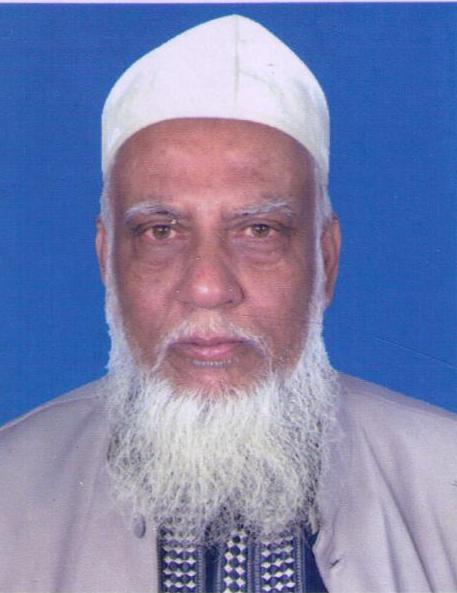
 This is a translation version of the original video documentary which was than transcribed and translated from Bengali to English. A book with the title of History of Bangladeshis in Greater Manchester has been published and it will be distributed to the libraries, schools and universities. The interview took place on 30th November 2007, so information about his personal family information may have been changed.
8.10 Alhaj Noorfor Ali
 8.10.1 Life in Bangladesh:
Alhaj Noorfur Ali was born in the village of Sikondor Pur, Balaganj (Osmanagar), Sylhet. His father’s name was Alhaj Abdul Karil and his mother’s name was Mendira Begum. He has two brothers and two sisters.
Upon completing his primary education he moved into high school. The high school was known as “Khuski Pur Manullah High School”. He studied up to the class of year nine and then left education. Every class year would consist between 50 to 60 students. The majority of class students were from Hindu background. In his high school there were 12 teachers.
He spent his childhood happily, during this time peoples living conditions were very good. Fish and milk was widely available. Farmers used to harvest a lot of rice during that period of time. Remembering from memory in 1955 a kilogram of rice would cost around 1.30 – 1.60 Rupees. Villagers owned a fair amount of farm animals.
His father worked on a board ship for 30/35 years. His job would transport him to different countries to work in and this took him to America where he worked there for seven and half years. Afterwards his father went back to Bangladesh.
8.10.2 Journey to the UK & Immigration:
When he was young he heard that if you obtained a passport from Karachi (West Pakistan) then it would be possible to get entry into the United Kingdom. He also learnt that there were plenty of jobs available in the UK. After learning this he and his 14/15 friends went to Karachi, West Pakistan. They stayed there for about one year. 5 of them arrived in Britain. It cost them 1400 Rupees to travel to Britain using Pakistani Airlines (PIA).
He arrived at Heathrow Airport in January 1960. After getting out of the plane, he felt extremely cold as he had not adjusted to the British weather. After exiting the airport a taxi was reserved for them, he showed the taxi driver the written address of his cousins’ house, the taxi driver took them to the exact destination.
The house was located on Brick Lane, 125 Oldham Street, London, where his cousins’ sister and her husband used to live there. The taxi journey took one hour, the taxi journey cost them £50. He knocked on the door and an individual wanted to find out their relation to the home owner. He replied that he is related to the home owner.
After that they were invited into the house, the cousin of Mr Ali greeted them and gave them warm clothing and took them to a well heated place whilst they all dined together. His cousin went to a shop and bought more warm clothes for them, he stayed there for two weeks. This house had around 6 to 7 rooms and it was occupied by 30 to 35 people.
8.10.3 Life in the UK:
In England there were not enough mosques for people to pray in but if they wanted to send their children to school for education then this option was widely available. He would pray at home but during Eid he would go to a mosque in Manchester.
When living in Hyde, there were about 15 houses and around 100 to 150 Bangladeshi people living in that area. Most of these people did not have their families living with them. About 2 to 3 people had their families with them. The reason for not bringing their family was that they weren’t thinking of settling in the UK.
After 1965 people started bringing their families into the UK. He used to spend his time playing cards and watching Hindi films or meeting friends during his days off.
8.10.4 Employment:
He visited another cousin in North London and was staying there. During his stay he was introduced into training as a waiter which lasted for one year. In 1961, his cousin went to Bangladesh which made him move to Hyde where there was another relative living in this area. After staying in Hyde for two weeks he received a job where he worked in a factory called Red Firm. It was a rubber factory.
His weekly wages were £20.00 and sometimes a bonus was awarded. Overtime was available for workers, when he learnt to operate machinery his weekly wages were £36.00. Here he worked during day-shifts for six months and then moved onto night-shifts. The factory conditions inside was well suited for workers which included heating.
The accommodation and food had to be arranged by the workers themselves, workers used to take their own meals to work but he used to live near the factory so he used to go home to eat during the day-shifts but at the night-shifts he would take his meal with him. Some of the wages would be sent to his father in Bangladesh after Mr Ali’s own expenses were covered. He worked there for 9 and half years and then went back to Bangladesh in 1970. The Pakistani airlines fare cost £250 but the airways returned cost 1400 Rupees to every passenger.
In 1982, after spending ten years in Bangladesh, he returned back to England. He noticed a lot of changes in Britain which he was unaware of. Factory workers were able to get their jobs back after returning from their holidays, however his factory had closed down and factories were becoming derelict. He found a job in an aluminium factory in Aston where he would make kitchen cookery equipment. He worked there till 1987. The weekly wages were £75.00. He worked with English workers therefore he eventually learnt to speak English.
In 1968, he entered into a partnership of a restaurant whilst he was working in the factory but later on he sold his share in the restaurant. During those days Mr Ali used to work 60 hours weekly, the weekly wages were £36. Mr Ali says that ‘‘in those days £36 were good wages’’. In some weeks he used to work the whole week without taking a day off. In Hyde there weren’t many hard workers like himself available.
Factories were closing in Britain and this resulted in Mr Ali becoming unemployed like other factory workers. He tried to work in a restaurant but because of his age he was unable to work and now is on relied benefits.
8.10.5 Housing:
He lived in a rented house in Hyde which was shared with other people. The rent would cost per person 12 shillings. He had to share one room with three people and they would all contribute in cooking. The house did not have central heating and coal had to be used for heating purposes. It was called the ‘Terrapin method’.
The toilet was located outside and during winter it was very difficult to access. He lived in this house for one year. This house belonged to his relative and this relative was going back to Bangladesh, at this point he bought the house for £250 in 1963. This house consists of five bedrooms, two reception rooms and a kitchen. At that time buying houses was not an issue; it was possible to buy a house by paying £50 deposit.
8.10.6 Social & Family:
In 1970, during his stay in Bangladesh he got married. One month before the liberation war he returned back to the UK with his wife. After passing 14 months in the UK with his wife his first son was born in March 1971. Upon hearing about the birth of the child, his father invited them to visit Bangladesh to see his grandchild and he went back with his family.
During this visit, the liberation war was over and it was the early period of the Bangladesh independence. Freedom fighters and anti war group clashed with each other and a court case followed, he was involved in this incident. He stayed in Bangladesh for ten years and his wife gave birth to one more son and daughter. Thereafter, his wife has given birth to two sons and one daughter.
His oldest son is educated and now works in a law firm in Britain and the second son has passed his a-levels and is working. The third son has passed his GCSE’s and is working and the fourth son is studying in a university while the fifth son is studying in high school. The oldest daughter passed her GCSE’s and got married. The second daughter worked in a clinic but cannot work anymore due to her illness. The third daughter is a school teacher and the last daughter is studying in high school.
In 1965, an elderly person from his village did his prayer by using a room which was granted by Mr Hasan Khan. If a Muslim person died then the body would be showered and then a prayer will be held in Manchester in memory of the person who passed away. The Land was purchased from the council to make a burial ground for Muslim people. This was possible due to Mr Hasan Khan and others who contributed money towards the purchase of the land in 1966. Muslims in Hyde who wished to pray, bought a house so then they could pray.
For the improvement of the British Bangladeshi community he has been involved with activities strengthening links even till this day. He was elected as a Vice Chairman for the Hyde Bangladeshi Welfare Association. He was regarded as being a very dedicated and religious person who has devoted his life to provide voluntary work for the benefit of the mosque. Since 1996 he has been the managing committee Chairman in the Hyde mosque. Children have been receiving religious education from this mosque. Due to free time he decided to go to Makkah to do the pilgrimage (Hajj) in 1991.
8.10.7 Independence of Bangladesh:
He is extremely happy with the independence of Bangladesh but he is not satisfied with the present situation of the country, especially with the fact that everyone is taking bribes. Government officials are not helping stabilise the country by providing jobs for people and are accessing the public wealth.
During the war in Bangladesh, Bangladeshi people provided support by holding meetings and talking to British officials to help support the independence of Bangladesh. From different parts of Britain, Mr Islam from Hyde and Mr Motin from Manchester held talks regarding the war.
8.10.8 Conclusion:
In Britain, Bangladeshi children were falling behind in education because the guardians were not focused on their progress in school. Nowadays guardians are becoming more aware to educate their children. He has five son and four daughters who have been educated in the UK.
At the present time he is a British citizen but he has deep feelings for the mother land of Bangladesh. With these feelings he frequently visits Bangladesh. Even his children have affection for Bangladesh. He has been successful in his own career in Britain and he is very happy that he has been able to educate all of his children. This may have not been possible if Mr Ali had stayed in Bangladesh.