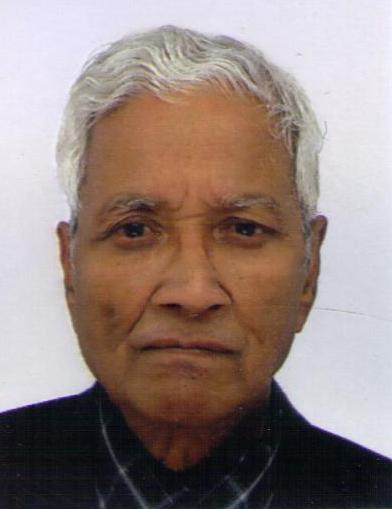
 This is a translation version of the original video documentary which was than transcribed and translated from Bengali to English. A book with the title of History of Bangladeshis in Greater Manchester has been published and it will be distributed to the libraries, schools and universities. The interview took place on 13 July 2008, so information about his personal family information may have been changed.
8.15 Alhaj Abdul Aziz
8.15.1 Life in Bangladesh:
Alhaj Abdul Aziz was born in 1942 in traditional Muslim family, in the village of Shaleswor Kuna, Bianibazar, Sylhet. His father’s name is Late Mohammad Khurshed Ali; his father was a farmer and a business man. His father used to have a grocery wholesaler shop and it was situated in the local Boiragi Bazar. Goods used to come from all different parts of Bangladesh, for example: Rongpur etc. His grandparents used to be very rich but it was not much during the time. His father used to maintain the family very well from agricultural work and business money.
In 1947-1948, per 40 kilogram of rice’s price was 5-7 Rupees. They used to do very well in agricultural work because their land was very close to the “Khushiara River”. When the river overflowed with water it used to bring new soils in the paddy fields. So, there was a good production of rice.
Also they used to get a lot of fish from the Khushiara River and small water ponds, in one hand there were plenty of rice and in the other hand there were plenty of fish. So, the local people used to maintain their families from agricultural work and fishing very well. In his childhood he saw that the fisherman used to catch a lot of fish from the river. He has 3 brothers and 1 sister; his eldest two brothers have passed away. In his village they used to have Hindu people and everybody was very nice.
He passed his primary school from his village then he went to a famous school called “Ponchokhondo Horgobindo High School”. The school was based in his home town. From that school 1957-1958 he prepared for his Secondary School Certificate (SSC). Before that there was another famous school in Bianibazar, people used to call it “MA High School” but the actual name was “Dhukkini Muhon High School”.
It was one of the famous Schools in the Asam province. The School also had another name which was “Surma Valley” because it had earned the name and fame by providing good education. At that time, Teachers used to deliver good lessons to the classrooms, so the students did not have to employ any home teachers.
After completing the SSC exam he wanted to start a job. A Lawyer he knew helped him to find a job; the job was working as a clerk at the Judge Court in Sylhet. At that time, he was only 17-18 years old. During his employment he wanted to do law practice but he did not get the chance to do that. For about 3 years (1960-1963) he practiced as a court clerk.
8.15.2 Journey to the UK & Immigration:
In 1963, while he was working as a court clerk in the Judge Court, Sylhet. He heard from people and from the newspapers that there is a chance to go to Britain by “Employment Voucher”. Like other people he also completed a form and sent it to Britain. Four weeks later he received a reply from the labour ministry that an employment voucher will be forwarded to the British High Commission, Dhaka and he will receive another letter from the BHC. After a few days he received a letter from the British High Commission to get his Voucher. He went to the Dhaka British High Commission to get an Employment Voucher. At that time, he also helped about 4-5 thousand people by filing the application forms and applying for the Pakistani Passports.
He came to Britain in 1963 with an “Employment Voucher”. He flew by Pakistani Airlines (PIA) and arrived at London Heathrow airport. The total cost of the processing of the paper work, obtaining the Passport and airlines ticket was 16,500.00 Rupees. In the same flight one of his friends Fojlur Rahman Khan came to Britain.
Fojlur Rahman Khan was living in Luton at the time. He did not feel scared during the flight as it wasn’t his first flight abroad. His relative came to receive him from the Heathrow Airport, and then they went to London Cannon Street house. There was not much space for him to stay in that house, after 3-4 days he went to Birmingham Elizabeth Street to another relative’s house. He stayed 5-6 months in that house, and then he went to the Small Heath area in Birmingham.
8.15.3 Life in the UK:
He said “In the past, the life in the UK was very hard and now everything is very easy”. People who are coming to Britain now are in the golden age of Britain. During the 1960’s there was no carpet, bath radiator and heating compared to now. They used to use Coal to warm the house because it was too cold that time. There were not any facilities to have bath either, they used to go to the public bath to have bath. It was hard to sleep and etc because there was not much space. They even had to sleep under the bed; also they had to share a single bed with other people.
8.15.4 Employment & Business:
While he was living in Birmingham, he was looking for a job but there was job crisis at that time. A few months later, he found a job in a factory. His first job in Britain was in a factory. The Factories name was Harrison. He worked there for 4 weeks. He used to get £7.00 to £8.00 per week.
From Birmingham he went to Bradford to his friend’s house. He stayed there for 3-4 months but he did not find any jobs. His friends helped him to find a job in the Manchester Bolton area in a cotton mill. He worked there as a “Machine Operator” for 3-4 months. His wages were £7.00 to £7.50 pound per week.
He used live on George street in Bolton. He stayed there for 3 months, during this time his relative Syed Abdul Hannan who was from Liverpool opened a new restaurant and offered him a job to work there. He started working there as a waiter and his weekly wages were £5.00.
He said “the owner of the restaurant offered him free food and accommodation with the job but the Factory did not provide this facility”. These are the reason for him transferring to a job that paid less, so he could get accommodation. So, he thought it was good. He worked there for 7-8 months and he used to live in second floor of the Restaurant.
In 1965, there was a Restaurant called “Ojontha” in Ashton-Under-Lyne; he started to work there. He worked there for 1 year then in 1966 he bought a Restaurant in Ashton as a Partnership. They spent £10,000.00 and the name of the Restaurant was “Gate of India”. At that time it was one of the big Restaurants in Manchester. During that time it was really hard to maintain a business compared to this time. The business income was really good but some of the customers were very rude and they used to fight as well. Senior staffs used to say to the new staff that do you have insurance for your nose; they used to say that as a joke.
They used to get extra people for the weekend because of the customers fighting, rude attitude and not paying their bill for the food. They used to prepare themselves for fighting. When he came to Britain it was really hard for him to speak in English and understand what they were saying. He studied English when he was in Bangladesh and now that he was in Britain it was slowly getting better.
It was a really good business. There were 4 partners including him, for the first few weeks they didn’t get paid any wages because they had to make bill payments. After that they used to take £5.00 per week for their wages. About 38 years he was involved with this business. In 2004 he retired from that business due to his personal health problems and his children did not show any interest to get involved with this kind of business.
8.15.5 Housing:
Since his arrival to Britain he lived Birmingham, Bradford, and Bolton. In 1965, he came to Hyde in Manchester. He used to stay in his relatives house. He used to stay in a rented house with his friend. Per week he used to pay £1.50. In 1967 he bought a 4 bedrooms house in Ashton-under-Lyne area in Manchester. For 1 year he paid 900 hundred pounds in a private mortgage. That was his first house in Britain. He managed to pay all the mortgages in time. In 1975 he bought another 3 bedroom house, which was built 1963 and he paid £8,000.00 for it, also he bought a few houses and he sold them after.
8.15.6 Social & Family:
In 1972, he went to Bangladesh and he got married in his local area. In 1979 his family came to Britain. He has 4 sons and 2 daughters and they’re all well educated. His eldest son obtained undergraduate Degree in Business Hotel Management and Masters Degree in Information Systems management and he is currently working for Balfour Beatty Workplace as a Planning Co-ordinator.
His eldest daughter obtained a BSC Degree in Computing and she is working for Cisco Systems as a Senior Network Engineer. His 2nd son obtained a Degree in Business Studies and is working a Branch Manager for Carphone Warehouse.
His 3rd son obtained a Degree in Product Design and now he is working for New Charter Housing Association as a Tenant Finance Officer. His 4th son completed his degree in Mechanical Engineering and is also a Qualified Mortgage Advisor and works for the Co-Operative Bank now he is also involved in selling vehicles and renovating residential properties and his youngest daughter just completed her Masters Degree in Architecture and works for an Architectural practice in Leeds.
8.15.7 Independence of Bangladesh:
In 1947 during the India partition he used to study in a Primary school. During the War in Bangladesh he was in Britain and he helped a lot of people in Bangladesh. That time the Restaurant Owner had to pay a large amount of money to help people in Bangladesh. After the Victory of Bangladesh in 1972 he went to Bangladesh.
8.15.8 Conclusion:
At the moment in his free time he goes to Bangladesh to see his relative’s, also he helps his relative’s. After he came to Britain he managed to establish himself and now he is really proud and happy about his children’s education and jobs. He also said about the new generations that they will understand and maintain their Bengali heritage and culture.