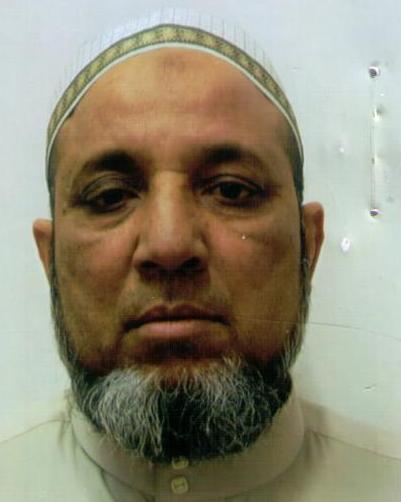
 This is a translation version of the original video documentary which was than transcribed and translated from Bengali to English. A book with the title of History of Bangladeshis in Greater Manchester has been published and it will be distributed to the libraries, schools and universities. The interview took place on 12 January 2008, so information about his personal family information may have been changed.
8.17 Alhaj Muktar Ali
8.17.1 Life in Bangladesh
Alhaj Muktar Ali was born in traditional Muslim family in the village of Shingerkas (Shekerghaw), Bishwanath, Sylhet. He was born in 1952. His father’s name is late Haji Yunus Ali and his mother’s name is late Haji Joygun Bibi. His father was living in the United Kingdom. He is the only son and he has 4 sisters in his parent’s family.
He went to the local Primary School and studied up to class three. At that time there was a Hindu and two Muslim teachers in the school and in his village there were two primary schools and there were about 4-5 thousand families living there.
His father was involved with agriculture work; he had some paddy fields where he used to work, income from this cultivating work made sure that his family was well maintained. His father had some primary education but his two uncles were educated as Munshi. His grandfather had some education and they had four houses in one boundary.
8.17.2 Journey to the UK & Immigration:
In 1957, his father obtained a Medical Voucher to enter to the UK. On the next day his father got the visa to go to the Hajj (Pilgrimage), so he went to Saudi Arabia to do Pilgrimage, when his father returned from pilgrimage he decided not to come to the UK but at a later stage in 1961 his father came to the UK.
In 1967, he came to Britain with a Boy Voucher as a licence to enter the UK. He paid 12,000 Rupees for airlines fare. The currency rate was £1.00 equal to 18 Rupees. He flew from Sylhet to Dhaka then flew from Dhaka to Karachi by PIA and arrived at London Heathrow on the 24th September 1967. His father received him at the Heathrow Airport and brought him to Walsall to live.
His father was living in Walsall, Birmingham and he started to live there. He was 15 years old when he first came to the UK. There was a very limited opportunity for him to do study. Many Bangladeshi people did not give the priority to do study, his main intention was to work and retire and go back to his home country.
The house where he used to live consisted of 9 rooms and about 40 peoples were sharing the accommodation. Some people used to live in single room and some people used to share rooms. At that time there was a good relationship with people, people used to accept other people as their brothers.
The price of 45kg rice was £2.50. Fish was not available at that time; he used to eat meat and chicken and usually dined at his own home. There was one grocery shop in Manchester where people could buy fish from. There were no Bangladeshi grocery shops in Oldham at that time.
8.17.3 Life in the UK:
The weather was very cold; people used coal to warm up the room. In the morning sometimes he used to eat rice and curry as breakfast. The snow and ice was common weather everywhere.
In 1968 there was there was heavy snow fall in the UK. The roads were closed due to this. The authority then had to clear the ice from the road and then people were able to use transport. This was repeated so many times, he added.
At that time, there was a Mosque in Oldham at Church Hill Street, which was established with help from Abdul Matin and others. The special Eid prayer used to be held there. The people had to apply to their workplace to get authorised leave for Eid day. If anyone attended Eid on a work day the manager or supervisor encouraged that person to take leave and celebrate their religious festival.
There was good an understanding and co-operation amongst Bangladeshis, if there was a death in the community, the people came forward to raise funds in order to do the funeral. Sometimes they had to send the dead body to Bangladesh and sometimes they used the local graveyard to do the funeral held in the UK.
8.17.4 Employment:
When he was 16 he started to work in the UK in the metal Industry. His starting wage was £5.00 and he used to work 40 hours a week. Usually the married person used to get more wages than a single people.
He used to live with his father therefore his father used to pay for the food and accommodation. The rent for the accommodation per head was 50 pence. At that time many people used to eat chicken curry for most of the week and once a week meat curry only due to limitation of grocery shop. There were one Bengali and Pakistani owned grocery shop in the Walsall area.
In 1968, he came to Oldham. He started job in a cotton mill as a labourer, at a later stage he was promoted from labourer to machinist. In 1973 he became the staff supervisor of the mill. There was a shift work involved with his job. His wages were £10.00 per week and he used to work there for 40 hours a week. There were workers from the white community but most of them were women. There were some Bangladeshi people. In 1972 his wages were increased to £200 – £250 per week including overtime.
He would usually have his breakfast at home, there was a canteen in the factory and he used to take his lunch there. From 1968 to 1986 he worked in the cotton mill. After that the mill was closed down.
8.17.5 Housing:
He bought his first house near Monor Mill. There were equal numbers of people presence from Bangladesh and Pakistan community.
At present times there are about 15 thousand Bangladeshi and 20 thousand Pakistani people living in Oldham. In the past there was about 5/6 hundred people living in the Oldham area. There was only 3/4 Bangladeshi families in Oldham. 15 to 20 people used to live in one house. Most of the Bangladeshis used to live near the Grange School in Oldham.
8.17.6 Social & Family:
In 1972, after the liberation he went to Bangladesh and got married. He stayed there for about six months. In 1986 his wife and two daughters came to the UK. His father went to Bangladesh and never returned.
He has reflected over his past memory and told that he can remember where he used to play kabady, football and so on as a child. He sometimes asks himself “why did I come to UK?” He also mentioned that he was a young minority amongst the Bangladeshi community. Most of the people were older than him. He had the opportunity to learn spoken English while spending time with the Bangladeshi community.
He has three daughters and one son. One girl is working in the Hospital as a nurse. Two other daughters are studying and his son is working in Tesco.
The Bangladeshi community is doing better compared to the previous period. The children are now going to universities and obtaining degrees. He thinks that the parents and community both need to be more anxious and provide necessary guidance and support to their children. He said “All parents should have the responsibility to maintain the family ties with Bangladeshi relatives and taking children to Bangladesh is also important”.
8.17.7 Independence of Bangladesh:
At the time of liberation he was in the UK. On 19th March 1972, he went back to Bangladesh. He was one of the activists for the independence of Bangladesh. He also recalled his memory and said Bangladeshi people played a vital role in that period.
In Manchester Mr. Matin was a leader to devote his time for organising meetings. He was the owner of Sylhet Travels. Mr. Matin lead the movement in and around the UK. He was the president of Manchester region. Mr. Gous Khan was the leader from London and he had originated from Biswanath, Sylhet.
At that time of liberation, there were Mr. Matin, Dr. Kabir, Somuj Ali, Moksud Ali Khan who worked together to achieve the goals of independence. Cornell Osmani and Abdus Samad Azad came to UK to unite the Bangladeshi people. Justice Abu Sayeed came to the UK and appealed all the Bangladeshi people to help the freedom fighters. He confirmed that they collected £20.00 per person as a donation to help the country. He also confirmed that the fund used to be sent to India then transferred to Bangladesh.
At that time of the liberation, all the Bangladeshi people who were living in the UK supported the war against the west Pakistani aggression. The Bangladeshi people organised a rally and demonstrations at the Trafalgar Square, Hyde Park, and Downing Street in support of the independence. He said “The Pakistani people often tried to get involved in an argument and tried to stop us doing our Campaign in favour of our native country”.
There were very limited telephones and televisions at that time. Somuj Miah, Abdul Matin, Hushiar Ullah had the television set. The people used to gather to their houses to hear the news about the war. Some people got together and bought second hand television sets to watch the news.
He said 3 million people sacrifice their lives for the independence of Bangladesh but due to corrupts and selfish leaders Bangladesh is now going backwards.
8.17.8 Conclusion:
In his conclusion he said our community needs to focus more on education. He is working as a volunteer with the local councillors for the development of Bangladeshis living in Oldham. He wants to see our young people make further progression in education and employment.
He also said that his children have been educated due to the fact that they are in the UK. If we did not have the opportunity to come to the UK then it would have been more difficult for our children.
The children who are living in the UK and missed the education due to negligence, they are definitely missing the opportunity which they will suffer for. He also added, a proper administration can offer the community the best services which they deserve. He received an award from local council for his tremendous voluntary community work.