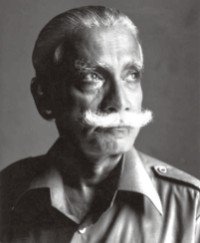
 General Mohammed Ataul Gani Osmani the Commander-in-chief of the liberation forces, was born in 1918 in an aristocratic family in the Sylhet district. He was the direct descendant of Hazrat Nizamuddin Osmani accompanied by Hazrat Shahjalal along with other followers. They came over to Sylhet in the 13th Century to develop the standard of Islam in this part of the country, which was then ruled by King Gour Gobinda.
His father Mafiz Uddin Ahmed (Khan Bahadur). Though a high-ranking civil servant had a religious focus of mind and did not budge (shift) an inch from the path of truth and justice. Osmani was a worthy son of a gifted father who throughout his life, never bowed his head to injustice. Being a descendant of an enlightened family, he inherited the qualities and virtues befitting a saint.
He spent the early days of his life in Joyhat in the company of the children of Charles Rhodes, then home secretary of the province. He started his formal education at the Cotton School of Gauhati in 1929 at eleven. He showed his potential from the very beginning.

One thing to be remembered is that his mother exercised a tremendous influence on him from the very of his boyhood. He imbibed all the inspirational propensities from his parents, which in later life, found expression in discipline tenacity of purpose regularity and punctuality.
In 1932, he got himself admitted to class IX in Government High School in Sylhet, on transfer from Assam. This time Sylhet Govt. High School was under Calcutta Varsity. He passed the Matriculation Examination in the first division showing extraordinary scholarly feats for which he was awarded the Pretoria Prize.
He deviated from the traditional routine of higher education in Calcutta and focussed his attention to Aligarh, the Muslim pupil of learning with a wider angle of vision. It was at Aligarh where he gathered all the potential to mould up his mental and intellectual make-up. The influence that Aligarh exerted over him, can hardly be exaggerated.
While he was a student in MA final year in 1939, the war clouds were gathering and it was fashionable at that time to rally around HM the king emperor, who qualified in the ICS examination, young Osmani did not choose civil service rather he took to King’s Commission. Thus he unfolded his military career. His early promotion was meteoric and at the tender age of twenty-three, he became the youngest Major serving in the British Empire. He proved his merit and mettle during the Second World War by conducting his units in different sectors of Burma, Iraq and Egypt.
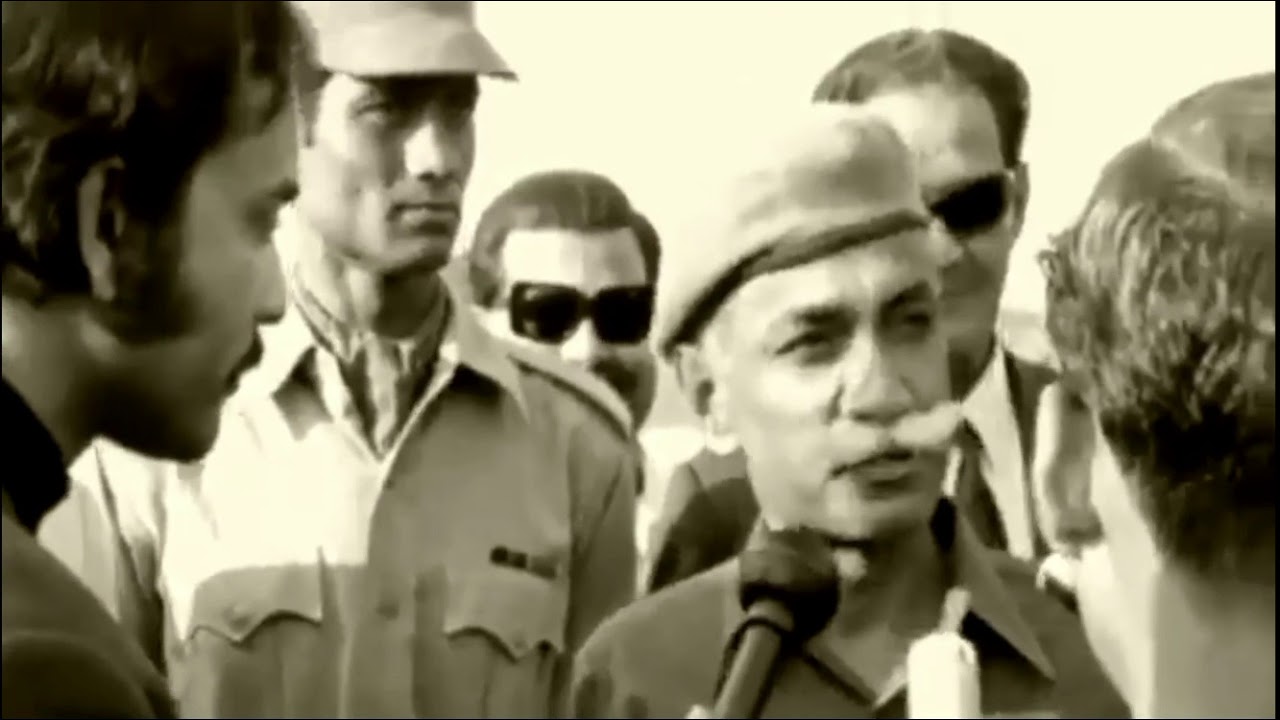
After the partition of the sub-continent in 1947, he gave his option for being enrolled in the Park Amy. During the infant stage of Pakistan, he owed his unwavering allegiance and loyalty to the state. But to his utter surprise, he found some anomalous treatment lurking in the minds of the rolling clique who were inimically disposed towards the interest of the Bangladeshis though they constituted the bulk of the population of the entire Pakistan.
He regretted the microscopic representation of the Bangalies in the defence forces. The stigma of non-martial race was being applied to the Bengalis. Other disparities in the sphere of the economy also cut him to the quick. These were the reasons, which eroded his sincerity and loyalty to the rules of Pakistan.
He pointed out to the rulers the glaring disparity existing between the two wings of Pakistan. Thus he incurred the displeasure of the authority and his sentiments were misinterpreted by many of his west Pakistani colleagues. He had a burning desire to consolidate the East Bengal Regiment, which he wanted to be manned by Bengali officers and personnel with a view to dispelling the stigma of being a non-martial race. The courageous and thoughtful Bengali soldiers of the East Bengal Regiment proved their braver in 65 wars in the Lahore sector.
For many years he lived in the Rawalpindi Club where he became a popular figure for his Army-oriented ways of life. He harboured no reservation or inhibition about his origin; rather he took great pride in proclaiming himself to be a son of the soil.
After serving in the rank of colonel for long ten years, he retired from the Pakistan army in 1967. His only offence was that he was a Bengali. So he did not get further lift though officers of other non-Bengali races enjoyed much more than they deserved. The revolutionary spirit in him rerouted against the injustice done to him may to his race. So involved himself with the Awami League, which was then fighting for the autonomy of the basis of six points.

During the Parliamentary Election held in 1970 to form the National Assembly of Pakistan, he was inducted into the political arena in the Awami League ticket and from now on, he became a right hand of Sheikh Mujibur Rahman espousing the cause of Bengali nationalism.
Meanwhile, the political upheaval went too far as to force him to rise up to the occasion and under the pain necessary he organised a regular Guerrilla Army to combat the challenge of the ruling military junta of then Pakistan. The die was cast and colonel MAG Osmani was transformed into a revolutionary General. The war of liberation culminated in victory under his active leadership.
He was a staunch advocate of democracy and he had all respect for democratic norms and spirits. He was one of the architects of the 72 constitutions, which were based on democratic doctrines. He set the finest example of parliamentary ethics when in 1975 he dissociated with the Awami League in protest against the formation of Baksal which foreshadowed the concept of one party state and this was for him the parting of ways. It was a credit to his memory that he did not lag behind in calling spade a spade. He was a lonely voice in the wilderness bemoaning the demise of democracy. Thus he was widely acclaimed as the champion of democratic rights.
But he did not alienate from the mainstream of politics rather he formed of Jatio Janata Party to project his political viewpoints before the mass as a never-failing friend of democracy. He was twice nominated by opposition parties to contest the presidential polls and he accepted the verdict of the people with a democratic gesture.
General Osmani was not devoid of milk of human kindness. He was magnanimous and endowed with all qualities of head and heart. Generous by nature, he gave with both hands but in return got nothing. He was humane, unpredicted and indifferent to material wealth. Ingrained with military discipline, he was systematic, methodical and logical both in words and in deeds. He was frank, straightforward, impartial, honest, upright and above all a perfect gentleman from nail to hair.
History will bear testimony that he concealed many others in respect of patriotism which inspired him to come forward as the liberator of the nation wherever the country was at the crossroads of politics.
Small in stature but big in heart, General Osmani presented a trim and sprightly countenance with his heroic moustache, which indicated a typical military gait. Led a life of celibacy, which was moulded up on the ethics of service to humanity.
That he is a legendary hero is admitted on all hands. His name has become a household word throughout Bangladesh. Allah fearing as he was, he was always guided by dictates of conscience. He never craved power by selling out or leasing out his conscience.
His death is an irreparable loss to the nation. The vacuum created by his death will never be filled up. He is no more in our midst but left us his ideas to emulate. It will be a fitting tribute to the late General if we can translate his ideas and dreams into action.