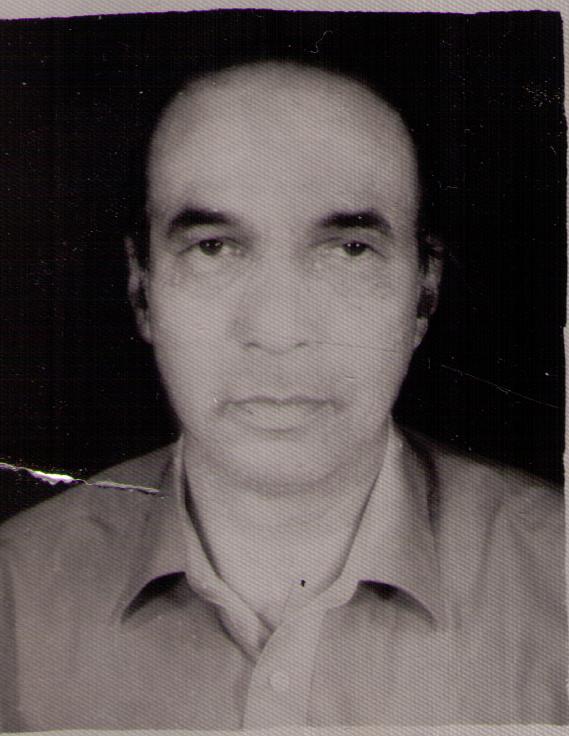
 This is a translation version of the original video documentary which was than transcribed and translated from Bengali to English. A book with the title of History of Bangladeshis in Greater Manchester has been published and it will be distributed to the libraries, schools and universities. The interview took place on 13 July 2008, so information about his personal family information may have been changed.
8.12 Alhaj Shomsher Khan

8.12.1 Life in Bangladesh:
Alhaj Shomsher Khan was born in 1940 in the village of Daorai, Jogonnatpur, Shunamgonj. His father name is Mr. Azim Khan. He has 4 brothers and 3 sisters and Mr. Khan is the youngest, he started his educated life at Local Jamar gaon Primary School, after that he went to Kujkipur High School, it was 5 miles from his house so he had to stay at someone else’s house and study. He stayed there for 8 years, in 1958 he passed S.S.C exam; he didn’t get into college due to his marks in English. He started teaching in primary school as an assistance teacher; he used to get 60 taka per month.
From 1960 to 1964 he did teaching. His father was in Britain from 1931 to 1949. They used to own 7 Acre paddy fields, during that time they didn’t have to buy fish or vegetables from the shop; sometimes they had to buy rice though. That time they used to grow their own vegetables and catch fish from the river etc.
8.12.2 Journey to the UK & Immigration:
In 1964 he came to Britain by voucher, he used to do teaching that time, then he found out about the form Voucher and he sent one form to Britain for himself. Within 1 month they replied to him saying that he will soon receive the voucher. After a few days they told him to get Voucher from the Dhaka British high commission, that time in Dhaka British high commission they used to ask people their date of birth and fathers name. If they weren’t able to give correct information then they wasn’t given the voucher.
Then finally he had gotten the Passport from the Sylhet Passport office and he got the final decision from the Dhaka British high commission. Then he got his ticket from the Aftab Ali office, during that time everybody used to get their ticket from that office and everybody used to know it. For his ticket it cost him 5 hundred and 50 taka.
Everybody was very upset that day when he was leaving Bangladesh to go to Britain. His brother was waiting at the Heathrow airport to retrieve him, his brother thought that flight would be delayed so he nipped out but the flight had come through the Karachi and France route so the flight arrived early.
At the airport gate he remembers showing his address and name to the taxi driver and the driver dropped him off at his cousin’s sister’s husband’s restaurant. The restaurant was called the East Bangle Restaurant. It was on Edgwar Road in London. He didn’t know how to open the door so the taxi driver helped him to open the door, then he went to the Kitchen and saw his brother.
Then he went to the “light of Kashmir” restaurant to see his brother. He did not like the food in the restaurant because there was a fixed time for serving food, sometimes he used to feel very hungry but he had to wait for the certain time that the restaurant would serve food. For this reason he went to his other brother’s house in Birmingham.
His brothers owned the house, after a few days his brother went to Bangladesh; before he went his brother shown him everything. He shown him that for the time being they had to use the toilet outside of their house and that they didn’t have any bath facilities inside their house.
8.12.3 Life in the UK:
He then told us about his first experience in Britain. Every week he used to go to the public bath to have bath and he would pay half crown for this. He used to use Cole to keep the house warm because it was too cold that time. The toilet was outside of their house. He did not have any problem with his English Language, during the work he did not have to speak much English, at first he had a bit of problem but then he slowly improved and he also studied in Bangladesh so he did not struggle with his English. Before his family came to Britain he had to cook and everything. That time Shopping was not easy compare to this time. There were not Bangladeshi vegetables and things that he needed during that time.
There was one Pakistani man who used to live in George Arther Street, in Ashton; there was a Chicken farm back side of his shop, they used to slaughter the chicken and take it to the house. The Raja Brothers in Trafalgar square usually had all of the meat. Also there was a sweet bar shop that used to sell rice.
That time there was a Pakistani Mosque in Birmingham but they did not have any Mosque that time in Ashton. They used to pray in a Church, and then in 1985 they bought the Church and built a Mosque there. In 1984 they opened the Bangladesh association in Ashton; in 1988-1991 he was Chairman for the Bangladesh association.
8.12.4 Employment & Business:
His first job in Britain was in a tube mill as a labour worker, they used to make brush pipes within them mills. One day he was looking for a job and he seen that there were people going in and coming out through the company door. He was looking at them and then he realized that someone was in charge, he went over and asked him “what do you want?”
He said he was looking for a job, the man in charge then asked him “do you want to start today?” He said “not today but next Monday would be better”. Then the man in charge accepted that he’ll come to work on Monday. He came on Monday and started his new job, there were other people from Sylhet inside the factory, and Mr. Mashuk Miah from Balagonj told him what he had to do in the workplace. During the work they had to use a few English words, for example: any more, not too more, not too much etc. It made it easier for the workers who owned the factory to understand.
His weekly used to be 28-29 pound; it was hard job in a factory and long duty, they used to work till Saturday, during the work they had to use gloves. During this time he used to work in a restaurant also and weekly he used to get 7 pound, also his food and accommodation was free. After that he used to work in gas board for good wages, there were 3 shifts of work and he was happy to do that. The wages he earned were really good. It was 10 pound more than his first jobs wages. When he had gotten offers for double shifts he used to feel very happy to do them because he can then get more wages.
He has got experience for looking for jobs, he mentioned that there was a factory that used to pay really good wages but the manager didn’t want to take anybody on for work. He went there and asked for a job, the manager then told him that he wasn’t going to give him a job. The next time he went back to the factory he had experience in looking for a jobs, he used to go to the factory every week for a job, one day he finally had gotten the job in that factory.
At the end of 1972 he came back to Britain, in 1975 he went to Bangladesh a second time. That time when he came back to Britain he did not find any jobs in the factory. That time his friend offered him a job at the Light of Bangle restaurant in London. He started working there as a head waiter. Weekly he earned 70 pound, he had worked there for 2 years. After that he worked in The Curry House restaurant for another 2 years.
In 1982 he came to Manchester, Ashton with his family. Then he bought a restaurant called ‘Ashton Tandoori’ with his 50% share for 6 thousand pound, he used to work in his restaurant as a waiter. Per week he used to earn 60-75 pound. During that time he owned a takeaway business but the Chef was not very good so he ended up selling the business.
8.12.5 Housing:
In 1972, during that time he used to live in a rented house with his family in London, Aldgate area, Colombia Road. In 1982, when he came to Manchester then he bought a house for 12 thousand and 5 hundred pound, unfortunately the Council took the house for the Magistrate Court. In 1989 he bought another house for 85 thousand pound and that is the house he is living at the moment.
8.12.6 Social & Family:
In 1972 he obtained his British Citizenship and went to Bangladesh and he had gotten married. In 1980 he brought his wife to Britain. He has got 5 daughters and 1 son; his children are all highly educated. At the moment he is a retired pensioner, in his free time he usually reads the newspaper, goes to the Mosque, goes to town and does plenty of exercise.
Sometimes he goes on holiday and he usually goes to Bangladesh, in Bangladesh he has relatives and brothers and sisters and much more family. He sold everything in Bangladesh and used that money for important things in Britain, for example business, house etc.
About 6-7 years he was involved with the association, when he first came to Ashton there were 5 Bangladesh families living there and in 1989 there were 15 Bangladeshi families living in Ashton. During his involvement the association he had to face a few problems, for example: Bangladeshi people used to go to the Council and complain for no reason. He also said there were a few educated people being involved in that.
8.12.7 Conclusion:
For the rest of his life he wants to spend it with his family because it is not important to go Bangladesh and leave his family in Britain. He also said it is impossible for him, he is a happy man, and he came to Britain because his children are all well educated, that wouldn’t be possible if they were all brought up in Bangladesh. He also said if you have 10 hectors field it is still very hard to maintain a family. He also notes that people have changed; they aren’t as friendly and as respectful as they once were.