 This is a translation version of the original video documentary which was than transcribed and translated from Bengali to English. A book with the title of History of Bangladeshis in Greater Manchester has been published and it will be distributed to the libraries, schools and universities. The interview took place on 11 May 2008, so information about his personal family information may have been changed.
8.33 Alhaj Mohammed Rafique Uddin:
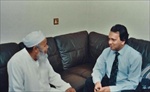 8.33.1 Life in Bangladesh: In 1943, Alhaj Mohammed Rafique Uddin (son of Mr. Arshad Ali) was born in the village of Doshghor Nowagaon, Bishwanath, Sylhet. He has 3 brothers and 1 sister, amongst them he is the second son. When he was 6 years old, his father died and his grandfather looked after him.
His father’s family originated from Binna Kandi, Khadimpur, Balagonj, Sylhet. His grandfather then moved to Bishwanath. During his childhood, his family used to own a huge amount land, so that would be where they received their income from and they were happily maintained. At that time, they had 13 lakes and 191.52 acres of land, they were very rich at that time but the Pakistani government changed the laws and they lost most of the lands and lakes. They still have huge amounts of land owned by his family.
When he was a child he finished his primary school education and didn’t get a chance to study at the High School. He used to walk to school and the condition of the school was very good. There were two Hindu teachers and two Muslim teachers; sometimes the teacher’s used to swap classes. After having the lessons at the School, there wasn’t any need to employ teacher at home.
Before he came to UK, he was involved with the family business. He used to purchase goods from India and used to sell them in the local market. He was 18 years old. He had a well-known person in the military in his family and he was advised to join with the Military. He went for the test and passed it and got the job. When he came home and told his mother, she did not allow him to go to Karachi for military training. He then submitted a medical report, confirming that he is not well and he quit the job with the military.
8.33.2 Journey to the UK & Immigration:
In 1957, he tried to come to Britain. The people who had the houses and businesses, they were able to sponsor people from different countries. His uncle gave him a voucher and then he obtained his passport and arranged his ticket, he flew from Dhaka by PIA and went to Karachi. He stayed there for 11 days and after that he came to the London Heathrow airport with his uncle who gave him the voucher.
He didn’t have any problems in the UK because he had his uncle with him. So, after completing the immigration procedures at the London Heathrow airport, he had taken a bus and went to London Victoria. From there, with help from an Italian, he took a taxi and went to Uxbridge to one of his friend’s houses.
He lived there for two weeks and moved to Bradford to his uncle’s house. From London to Bradford, he had to catch a train to go there and he paid 5 shillings.
8.33.3 Employment & Business:
He lived with his uncle for 4 months and went on benefits because he did not have a job at that time. After a while, a man who he knew arranged a job for him in a cotton mill in Bacup, Rawtenstall. His wages were £15.00 a week.
One of his relative Mr. Siddek Ali told him that he will get better wages if he comes and works in Rochdale. He started working in the factory in Rochdale and his weekly wages were £22.00.
After that he moved to a new job in the “Shaw Mill” in little borough. The wages were quiet good and he used to work 78 hours every week and used to get £40.00 – £45.00. At that time it was hard for Bangladeshis to get this amount of salary. He worked there for 1 and a half years.
He started a job in Cheltenham but afterwards he came to know that if anyone working in factory in Oldham was able to get vouchers they could bring people from Bangladesh. So, he came to Oldham and got a job in a factory.
In 1969, the factory announced that they have stopped giving out vouchers. After that he left the job and went back to Bangladesh. At that time he started a flying business in Bangladesh.
In 1971 when the war started in Bangladesh, due to this many businesses were affected and suffered a total loss. In 1972, he got married again and the main reason for the second marriage was his first wife couldn’t have any children.
In 1973, he came back to England and started an IP business. He was involved with this business from 1973-1975 and then went back to Bangladesh again. In 1979 he came back to England and started a job in the “Turner Mill” and he was in charge of that factory. Suddenly, one day he had fainted and after the medical check-up he became unfit. That was his last job.
He did not like to stay at home all day, so he started a restaurant business. He opened about 4 restaurants with partnerships with other people. One of the restaurants was in Aberdeen Shire, Scotland and it was known as the “Star of India”, that was his third restaurant. After 2 years he sold that restaurant and went to Makkah to do pilgrimage (Hajj). In 1988, he opened another restaurant but at that time there was some trouble with the customers and he decided to sell the business.
8.33.4 Social & Family:
In 1966, he went to Bangladesh and got married. After his marriage he left his wife in Bangladesh and came back to England in 1967. In 1982, he brought his wife to England and stayed in a rented house with his wife. In 1984, the house he is living at the moment was bought and he bought it for £800.00 from the council.
He is the father of 4 sons and 3 daughters. His eldest son has been studying in the UK and now he is working in a security company as an assistant director and he is married. His eldest daughter passed her A levels and she is married too and all his other children are studying.
In 1970, the first mosque was built by Bangladeshis, at that time he was in Bangladesh, so he didn’t get a chance to get involved with them but he was able to get involved with them at a later stage, when he returned to UK. He became one of the trustees for the Mosque.
He was involved with the Bangladesh community. He said “the Bangladesh Association” in Rochdale first started the community centre, afterwards they rented a house and bought a house and started working and it’s still working now. Mr. Gulam Rasul from Sheffield told the Bangladeshi community in Rochdale that there is an opportunity to get funding for the projects from the government.
Through his involvement the Bangladesh Association was able to obtain funding and set up a project to help the community. In 1985 he went to Makkah to do pilgrimage (Hajj). When he came to Rochdale for the first time he heard that 180,000 people used live there but now there are about 220,000 people who live there and amongst them 8,000 of Bangladeshis.
When he came to England he was very pleased working with English people. At the time, when he was coming from Victoria by taxi, an Italian guy helped him to get a taxi. After that when he showed the address, that guy told everything to the taxi driver and he put his luggage in the taxi for him and told him that the taxi driver will take him to the right place by body language.
If he had any problems whilst he was walking on the streets the English people used to help him, especially English women, they used to love helping people out. In the past, the weather of Britain was very cold. He said “I used to think that we would never have daytime because we didn’t see the moon or the sun and new generation would not believe this”.
8.33.5 First in the Town:
To the best of his knowledge the first Bengali in Rochdale was Mr. Harris and the first grocery shop owner was Mr. Syed and his English wife. The first restaurant was the “Omar Kayum” and the owner was Dr. Ahmed and his Pakistani partner. The second restaurant was known as the “Kohinoor Restaurant”.
8.33.6 Conclusion:
He still loves Bangladesh very much and therefore visits Bangladesh. He still misses his friends and relatives. He could not maintain the communication with people back home as he used to do in the past.
He is enjoying the time with his family and he is trying his very best to give them the right education that will enable them to go ahead in life. He urges the community to guide their children and encourage them to do more study in order to be successful in life. He is retired and is living a happy life with his wife and children.