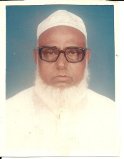
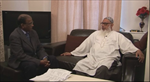
 This is a translation version of the original video documentary which was than transcribed and translated from Bengali to English. A book with the title of History of Bangladeshis in Greater Manchester has been published and it will be distributed to the libraries, schools and universities. The interview took place on 15th January 2008, so information about his personal family information may have been changed.
8.13 Alhaj Kari Abdul Baki
8.13.1 Life in Bangladesh:
Alhaj Kari Abdul Baki was born in 1938 in a traditional Muslim Talukdar family in the area of Nadampur, Nabigonj, Habigonj. His father’s name is late Mohammed Abdul Kamil & mother name is late Firuja Begum. His father was living in the United Kingdom; his father got him as a boy using a boy voucher, he was the only son and he had one sister.
His first school was the “Mostofapur Primary School” and he had spent his secondary education at the “Digolbagh High School”. He studied up to the class of nine, he then moved to Islamic institution to do religious study; he studied there for about 7/8 years and received the title of Kari.
His father was working on a British board ship; he maintained his family easily due to his own income from the paddy field and there was income from his father’s employment. His village people were very poor, due to this he has seen many people having to struggle to survive for their life. He has also seen that the village people could not afford to pay for their children tuition fees. For the economic, this was the reason why many children in his village were left uneducated. In his school life, he has seen more Muslim children than Hindu children.
In the British period, 37.5 kg of rice was only 5 Rupees and at Pakistan period, the price went up-to 10 Rupees. During the British & Pakistan period, the people relied upon income from agriculture. Many people used to work as a labourer, there were shortages of necessary goods. There are some goods, which used to sell at a cheaper price from the government agencies, even the kerosene oil. The people used to suffer a lot due to this. He went to Chittagong to search for a job. He spent six month there and returned to Habigonj without any success. In 1961, he went to Assam in India and found a job in the mosque to work as an Imam.
8.13.2 Journey to the UK & Immigration:
Mr. Baki’s father retired from his job and returned to Bangladesh. At that time people could come to UK through the voucher scheme. In 1964, he came to UK.
Mr. Baki flew by KLM airlines from Dhaka Tej-ghaw Airport and arrived at London Heathrow Airport. His connecting flight was to Manchester but there was some delay from Heathrow Airport and he requested to the Airport authority to arrange a train ticket for him. The airport authority arranged a train ticket for Mr. Baki.
He arrived at Manchester Piccadilly, took a taxi, and went to the restaurant. He found that the restaurant had been closed. The weather was very cold and foggy, he found a telephone booth, and he enters into it to protect himself from cold weather. The people who were supposed to receive Mr. Baki from the Piccadilly train station went to Victoria station by mistake. He waited outside the restaurant and after few minutes later, the people came back from Victoria station.
8.13.3 Employment:
His UK working life had begun at a Restaurant, working as a waiter and living above the restaurant. Food and accommodation was free and the weekly wages were £7.00. He used to work 12 hours a day, six days a week. He has some knowledge of English and the employer provided some language support, he worked there for about 4 months and left the job.
He then found a new job in the factory with good pay (wages). He moved to Dunlop Textile in Rochdale and worked there as a labourer, the weekly wages were £18.00; also, if he worked on Saturday, he used to get another £4.00. That was a total of £22.00 per week, double money, better pay compared to the restaurant job.
During the above employment, he used to live at the flat just above the restaurant. While he was working in the factory, he worked during weekend at the restaurant. Due to his part time work, he used to get £4.00 and the accommodation and food was free.
He used to travel by bus from Manchester to Rochdale and the fare was 20 shilling, he worked in Rochdale for about a year and then moved to Oldham. At that time, there were many mills and factories in Oldham. He joined a woollen textile mill; he worked in the spinning and welding section. As for health and safety, the precaution was to wear masks and ear covers for every worker that needed to be used whilst on duty. There was trade union support for all the workers.
If there was a demand to increase the wages, than the trade union advised the workers to strike against the employer, the factory had to close many times due to strikes.
He did not have any language problem because he had the English language skills. In his job, sometimes he used to do the interpreting for other workers and newcomers in the factory, he also used to provide help and support to the community by taking them to the Office and the Hospital. He also helped many people to fill official forms and writing letters.
8.13.4 Housing:
He bought a three-bedroom house in Oldham town centre; He paid £300.00 for leasehold property. He was living there along with 7/8 other tenants. He used to received rent £1.00 per person, then it was increased to £1.25, £1.50. There was no bathroom in his house and he used to go to the public bath like others. The charge was 1 shilling to use the public bath. The toilet was outside the house.
The weather was very cold. He could feel it when he travelled to work. It was a very hard life in Britain and people had to suffer a lot.
In 1968, he bought a freehold house in Oldham town. The price was £500.00. The house was consisting of 2 bedrooms. In this house, there was also a toilet. He bought another house; he carried out some improvement work in the cellar.
8.13.5 Social & Family:
In 1981, his wife & two daughters came to UK. His second daughter sadly died years later in United Kingdom. His eldest daughter is working as a teacher and his eldest son obtained a Chemistry degree from University of Manchester and now working in Qatar as a teacher. His second son obtained an Economics & Finance degree from same University of Manchester and now working in the Bank. The youngest daughter is working in the government sector.
The children have a connection with Bangladesh; they studied the religion with their own interest. His children often ask questions about Islamic history, For example, they asked where the hand written script of Holy Quran had been kept. From his own knowledge, he replied to his children that a copy has been kept in the Taskand Museum, Russia, which was the first hand written script by a Hazrat Usman Gani (RA) [PBUH]. A copy has been kept in British Museum, the written script was written by Hazrat Imam Hasan (RA) [PBUH].
One day, his son asked him a question about Hazrat Mohammed [PBUH], he asked why the prophet marry six years old Aysha Siddiqa (RA). Mr. Baki told his son that was an engagement; Mohammed married Aysha (RA) when she became 12 years old. He also added according to the Islamic Sharia, 12 years was acceptable at that time.
There were a few mosques in different town and cities, compare with the present time. Many people used to do Salah at their own home. There was one Bangladeshi and one Pakistani Mosque in Oldham area, at that time if anyone died in the community, the people was involved and used to send the dead body to Bangladesh.
8.13.6 Independence of Bangladesh:
At the time of the liberation period all Bangladeshi people who were living in the UK were supporting the war against the west Pakistani aggression. The Bangladeshi people organised rallies and demonstrations in many places throughout the UK. He also joined the support of the independence of Bangladesh and attended many meetings.
Bangladeshi people organised fundraising & lobbying Campaigns. He has also taken the initiative to do a special prayer for the liberation and help bring peace for the people of Bangladesh.
Before he came to the UK, he had the feeling that west Pakistani authorities were depriving the east Pakistani in many ways. That was the reason for him to support the independence of Bangladesh.
After the liberation, Mr. Baki went to Bangladesh to see the condition of the country in his own eyes. About 365 people hired a charter plane to visit the new liberated country and he was amongst them. He was shocked to see the countries aftermath; he spent some time with his family, friends and relatives. He had been selected as a chairman of relief committee to distribute goods amongst the poor people in his own village.
8.13.7 Conclusion:
In his concluding remarks, he said when his children became 16 years old; he encouraged them to continue with their studies instead of working. That is why his children had the opportunity to obtain higher degrees from universities. He feels proud for his children’s best achievement.
He is enjoying his retired life with his family; Mr. Baki had been to Saudi Arabia four times to do pilgrimage. He hopes that the Bangladesh people will make progress and peace for all the people. Mr. Baki is an educated, social activist involved with the local community and hoping to spend the rest of his life in the UK.