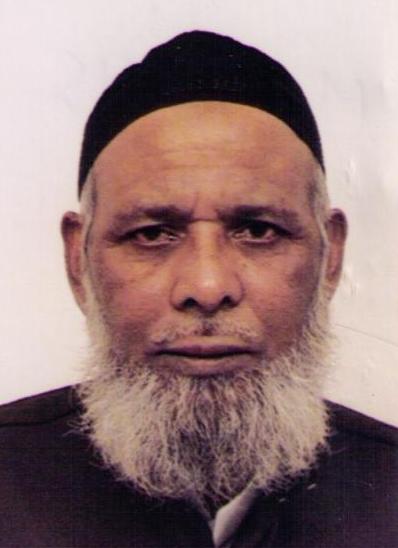
 This is a translation version of the original video documentary which was than transcribed and translated from Bengali to English. A book with the title of History of Bangladeshis in Greater Manchester has been published and it will be distributed to the libraries, schools and universities. The interview took place on 27 January 2008, so information about his personal family information may have been changed.
8.21 Alhaj Mohammed Anis Ali
8.21.1 Life in Bangladesh:
Alhaj Mohammed Anis Ali was born in 1942 in the village of Bui Gaon, Chattok, Sunamgonj. His father’s name is late Alhaj Mohmammed Azim Ullah. His father had some agricultural lands, where his father used to do the cultivation work and was able to maintain his family expenses through the crops that were grown.
He went to the local village primary school and was not able to study much. The reason for not being able to study was that he had to help his father with farming work. He was the oldest out of the two brothers. At that time school teaching was enough for a student and private tutor was not required.
8.21.2 Journey to the UK & Immigration:
When he was twenty years old he came to the UK through the ‘voucher scheme’. At that time if anybody wished to come to the UK it was expected to fill out the form in order to get the voucher. Then the people usually received a reply from the labour ministry and it was a procedure that people should obtain the passport and submit this to the British High Commission along with the voucher. Then the British High Commission, Dhaka invites people for an interview. He did the same thing, as many people did at that time.
The travelling costs to the UK were around 1650.00 Rupees. His flight started from Dhaka to Karachi by Pakistani Airlines (PIA) and then he stayed in Karachi for one day and then he travelled to Heathrow using British Airways. Another eight Bangladeshi people were with him throughout the journey. Everyone agreed that when they would arrive in UK they would travel to the same place together.
However upon arriving in Heathrow, all of them were taken for a medical check up. The medical check up lasted for an hour and a half and the rest of the group had left without waiting for him. After a while a Pakistani Taxi driver was approaching towards him and asked him where he wanted to go.
He showed him his destination address of a person living in the UK, which he received while he was in Bangladesh. The Pakistani taxi driver started his journey to the address. The Pakistani driver knew some Bengali and so they both spoke a bit of Bengali. The Pakistani driver took him to a different place in London. This was a Bangladeshi restaurant and the owner was Surat Miah.
The owner of the restaurant paid the fare to taxi driver. He contacted the people on the written address by telephone and a person came to greet him who was called Mr Boshir Miah. At 6pm on that day, they both travelled to the Euston Train Station in London where he caught a train to Halifax and he was informed that Halifax is the last stop, so he does not need to worry about this.
When travelling on this train he knew that when the train stopped at its last stop then it would be Halifax. Mr Boshir Miah also tried by checking the whole train to find another Bangladeshi person travelling to Halifax but unfortunately he did not find anyone at this train. Mr Boshir Miah gave him 2.5 shillings and a packet of cigarettes and also paid for the train ticket.
The train reached Halifax at 1am and he followed other people to find the exit. It was raining outside and was very cold. When people walked on the walkway then he saw couples holding their hands together. In the Muslim culture this sort of act would be considered shameful. Mr Ali felt shameful when asking for directions to places.
He was thinking and was a bit worried about how to reach the destination. At last he showed the address to an English person and the person lit him a cigarette and carried his luggage before setting off. The English man took him to a Pakistani’s house. The Pakistani people gave him food and then took him to another house were Bangladeshi people lived.
At 6am he was taken to another house were people resided from his village. He felt pleased to see his villagers. A fellow Bangladeshi called Husiar Ali gave Mr Ali an overcoat and made him join the labour. In a week he would receive £2.50 as labour and he was receiving benefits for a few weeks.
8.21.3 Life in the UK:
Comparing Britain from past to present he believes that in the past living was harder and uncomfortable; now it is similar to staying in his father-in-law’s house. At the past time UK’s weather was very cold and when people went to sleep a single person would use six to seven blankets to keep him warm.
He felt very cold inside the house. A kettle would have to be boiled in order to wash clothes. If there was too many people living in a house then there would be two cookers otherwise there would only be one cooker. He said “Cooking food was very difficult”.
There were no shower facilities and therefore he would take a bath in a public bath once a week. He saw that English people and other foreign people use the public bath facility. The queue would take two and half hours. Using the public bath would cost money. At that time people’s living conditions was under extreme hardship.
He saw an English person making a cigarette by using a Rizzler and tobacco. After seeing this Mr Ali asked Bangladeshi people why they did this, the answer was that it is cheaper than buying cigarettes.
8.21.4 Employment:
A few weeks later, with help from some people he received a job offer in a wool mill, Halifax. The weekly pay was £7.00; from the wages it would be used to buy food and pay for accommodation, while some money would be sent back home.
He worked in the factory as a trainee. After two months of working he learnt to operate the machines. The weekly wages rose to £11.00, he worked there for around nine months. In the hopes of receiving more wages he joined a job with Foundry. The wages would vary amongst £14.00 – £15.00 per week. He worked here for about four months.
The work in this factory was very hard because of being young this job did not suit him and that’s why he left the job. He found another job in a cotton mill. Work used to start from 8am till 10pm. He worked there five days a week and the weekly wages were £13.00. The job with this factory did not appeal to him so he left work and got another job in a mill.
This mill had a two hours overtime facility and the weekly wages were £15.00 – £16.00. He worked there for one year and moved onto another factory. The wages in the factory including overtime ranged around £24.00 – £25.00. The work started at 8am till 10pm. On Saturdays he would work overtime starting from 8am till 4pm. He worked at this factory for two and a half years. He had to leave the factory work due to his mother falling ill in 1968, he travelled to Bangladesh.
In 1969, he returned to UK and made an enquiry to his previous employer but unfortunately there were no vacancies at that time. Through different people, he came to know that there were some vacancies in Mosley. He got a job in a Wool Mill, he used to do night shifts and the weekly wages were £25.00 – £26.00, he worked there for three weeks. After that he found another job with high wages and moved onto “Greenfield Null Spinning Mill”, where he would operate the machines.
He worked there from 1969 to 1987. During working there he was not entitled to any annual leave, so it was difficult to visit Bangladesh. The manager of the company used to say to him that upon his return, if there is any vacancy that he would be able to re-join. He left the job and visited Bangladesh several times, and upon his return to UK he was able to re-engage with his employment.
8.21.5 Housing:
In the past, he lived in different places, shared the accommodation with other people. He described the condition of the houses as being awful, the toilet was located outside, coal was used to heat the house and there was no carpeting inside the house.
In 1973, upon arrival to the UK with his family and children, he went to his uncle’s house and stayed there for two days. Then, he went to one of his relative’s house at Malborough Street, Glodwick, Oldham, where he stayed with them for a few days. Then he moved to another relative’s house at Marlborough Street, Glodwick, Oldham and shared this accommodation with them. For using one bedroom, he used to pay £5.00 per week as rent.
He bought a house for £1600 on Sickle Street, Glodwick, Oldham, because of the experiencing difficulties of sharing in one house. The previous homeowner had an outstanding mortgage of £800.00 and he was to get the mortgage and paid the rest in cash. This property was a two bedrooms terrace house. This time, there was bathroom inside the house. The current house where he is living now was purchased in 1983.
8.21.6 Social & Family:
In 1960 he got married before coming to the UK. In 1968, he went to Bangladesh due to his mother’s illness and stayed there for nine months. In 1969 he came back to UK and was not able to work in the same factory upon return.
In 1972, after the independence of Bangladesh, he went back to Bangladesh. He made the decision to bring his wife and children to the UK but his mother did not agree to this. He said “in order to convince my mother, I told her that I will leave my oldest son and oldest daughter with you”. His mother accepted to this and so in 1973 he brought his wife and two daughters and one son to the UK.
During that time in Britain a son was born. The Hospital, did not release the baby and the mother, due to the fact that it was the procedures for the Hospital to keep them in their observation for ten days. This meant he had to leave work in order to look after his kids.
His mother fell ill again so he visited Bangladesh again. After this his mother made a recovery he returned back to Britain. After about a year later, he received a letter stating that his mother is ill again. This time he sold his house and went back to Bangladesh with his whole family. After his mother recovered he returned back to Britain on his own leaving his family in Bangladesh. His family stayed there for five years but he visited on occasions. Meanwhile, two sons were born in Bangladesh.
In 1980 his mother died and after that his father passed away. All of his children are educated in Britain. His two sons have been educated in Islamic qualifications. One of his sons is able to recite the whole Quran from memory. His son got title (Muhadis) degree in Hadith from “Faculty of Al-Azhar University in Mishar and now he is doing a PHD in a London University. One of his son’s is an optician. Their mother has been a great help towards their education.
Mr Ali was the Vice President of “Glodwick Bangladesh Society” and was the Chairman of the “Jalalabad Jameh Mosque” from 1994 to 2000. Due to diabetes he had to resign from his post. In 1987, he left factory work because it was closing down and he became medically unfit. In 2007, he received pension and now believes that the new generation of parents have affection for their children but also encourage their children to study hard.
8.21.7 Independence of Bangladesh:
In 1971 during the liberation moment of Bangladesh, Mofozzal Husain, Moksud Ali and Shomuj Miah organised a meeting in Oldham and requested everyone to donate their weekly wages to help towards Bangladesh independence. They are also advised not to send any letters to Bangladesh. Everyone present at that meeting made a promise that they will definitely support the cause. He abided by these terms. He used to receive letters from his mother but was unable to write back and felt very upset.
8.21.8 Conclusion:
He urged to all the parents to take care of their children and guide them, so they would be able to gain better qualifications and it will improve their life career. In his family, personal and social life, he has been a successful person after arriving in Britain but also has feelings for Bangladesh. He has visited Bangladesh several times to see his close relatives and friends. He also said “My children have respect for Bangladesh and still want to visit there”. At the moment he is retired and is going to spend the rest of the time with his grand children and family.