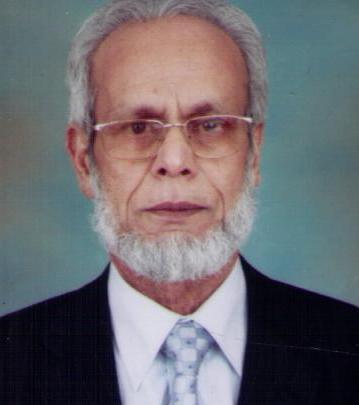
 This is a translation version of the original video documentary which was than transcribed and translated from Bengali to English. A book with the title of History of Bangladeshis in Greater Manchester has been published and it will be distributed to the libraries, schools and universities. The interview took place on 16 January 2008, so information about his personal family information may have been changed.
8.29 Alhaj Khondokar Abdul Musabbir MBE
 8.29.1 Life in Bangladesh: Alhaj Khondokar Abdul Musabbir was born in 1939 in the village Hajipur, in the area of Balagonj, Sylhet. His father’s name is late Komor Ali. His father was a religious Imam and worked in the local Mosque in his village. He has 4 brothers and 4 sisters, amongst them he is the youngest. He completed his primary education from “Tajpur Primary School” and went to “Mongolchondi Nishikanto High School”.
Although his father did not have much land his family members were happy. When he was young his father passed away. Remembering his father death, he feels a lot of grief, which he cannot tolerate. Due to his father’s death, he was unable to complete his secondary education. Then he started a cloth business in his village. He was responsible to maintain his parents family, whilst his eldest brother was in the Police force, second brother was responsible to look after the home; third brother was an Alim (Islamic Qualification).
He was involved in this business for 6-7 years. When he was young he enjoyed his loved life, at that time the village was much better. Everyone in village cared about each other, they trusted each other, and if there were any problems or arguments everybody used to solve the problem together. When he started the business he was a secretary and if there were any problems the bazar committee would help solve the problem and so would the village, it was such a good time.
8.29.2 Journey to the UK & Immigration:
In 1963, he came to the UK with a “Labour Voucher”. He heard this news one of his school mates that people are going to Britain through the “Labour Voucher”. He then went to the Employment Office in Sylhet and collected the Application Form there. He also took some forms for his friends and relatives too. He completed all his forms and posted these to the Employment Ministry. He also kept copy of the forms in his file, so they did not have any problems later on.
Three months later, he received an acknowledgement letter, which confirmed that within 6 months, he will receive another letter, which will enable him to get the Voucher. When he received a call letter, he then went to the Passport office in Sylhet and obtained his Passport from there. After collecting the Passport, he went to the British High Commission, Dhaka to get his Voucher from there. At that time, there were about 10 of his friends that went to Dhaka at the same time.
Before going to the British High Commission, Dhaka, they went to the local restaurant to have some breakfast. There were some other people, seen this group of people are planning to go abroad. These people asked where about they are planning to go and they have obtained the paper work. In response to their question they said “We are going to the UK with our Employment Vouchers and it is costing us about 1,600.00 Rupees”. These people were surprised to hear that the amount of money, they are spending too much money for going to Britain. That is because, with the amount of money, anyone can do a business at that time.
After collecting the voucher, he returned to Sylhet and went to the travel agency in Sylhet. He sent a telegram to his brothers, who were living in the UK. He mentioned in the telegram that one of their relatives is coming to the UK; they need to go to the Airport to receive them. He did it purposely to give them surprise, so he did not mention that he is coming to the UK.
In 1963, he arrived at London Heathrow Airport and his eldest brother went there to receive him from the Airport. His brother was surprised to see him at the Airport, because the telegram message was completely different, there was no mention of him coming to Britain.
8.29.3 Life in the UK:
Now in Rochdale about 6/7 thousands Bangladeshi people are living there. In 1963 when he first came to Rochdale to live, at that time there were no Bangladeshi families living in Rochdale. Everybody was single at that time. 5-7 people or 15-20 people used to live in one property. Many of these people used to work in the factories. The people used to prepare their meals by themselves.
They used to cook curry on Monday for the whole week and used to cook rice every day due to lack of time. The people who used to work in the restaurant did not have to prepare their meals as there was free accommodation and food was included by the employer.
When he brought his family in 1973 there were 5-6 families in total living in Rochdale.
In 1963 there was no Halal Grocery Shop in Rochdale but after that the first grocery shop opened by a Pakistani and then Bangladeshi came forward to open shop in this area. At that time, there was only one Mosque in Rochdale called the “Sonali (Golden) Mosque”.
He could not come to Mosque on Friday due to his work but he used to go to the Mosque when he had holidays. In the past, there were plenty of job opportunities in the factories; therefore many people came to Rochdale including Bangladeshis. The weather condition was really bad; he used to feel cold during the summer, which is the current temperature in the winter.
8.29.4 Employment & Business:
He came to Rochdale, where his brother used to live. After about two weeks later, his brother took him to a factory, where he was working. His brother took the permission from the manager and shown him around the factory. On the next day, his brother told him that he has spoken to the factory manager and got him to offer a job for you and job has been arranged, if he wants to start work immediately then he would be able to do so. He said “Can you find any other jobs, as I am not interested to work in the factory”.
Then his brother took him to one of his friend’s restaurants in Manchester. The name of the restaurant was the “Everest Restaurant”. He had a job of the “Trainee Waiter” and his starting wages was £5.00 week and he used to get weekly tips of £3.00 and altogether he used to get £8.00 a week at that time. He shared this information with other people and they said it is good wages compared with the factory wages.
He used to keep some money for his pocket expenses and deposited all his money to his brother. At that time, the wages of head waiter was £10.00 per week. He worked there for about two years and then he went to Brighton with his brother. He got involved with first restaurant business in the UK. The restaurant was situated in the sea side, so the business was good only for 4 months and remaining the 8 months was always really quite.
They decided to close down the business and they came back to Rochdale again and started working in the factory. After that one of his brother’s friends called Yousuf Miah forced him to take employment in his restaurant in “Ashton-under–Lyne. After working there for few days, he became partner with him.
In 1972, he took three months leave from the business and went to Bangladesh but due to some family business, he had to stay there for 15 months. During that time his partner messed up the business and he left the partnership. He got married in 1961 before he came to England and he brought his wife with him to England in 1973.
After working in the factory for quite some time, he left the factory job and in 1978 got involved with the restaurant business. This business is known as “Star of Bengal”. He paid £25,000.00 for this business, £12,000.00 cash and rest of them from a business loan. This business still exists, he has now retired and his son is running the business. He reflected his past employment life and he said “Father Gallon Hervey was 3 miles way from Rochdale”, where he used to work as learner and his weekly wages were £15.00. He also worked at “Turner Brothers” and “Great Mill”.
8.29.5 Housing:
During that time he and his wife were living with his brother in Rochdale. Later on he bought a 3 bedroom house in Rochdale for £600.00 and started working in the factory again. At that time the price of two bedrooms house was around £200.00 to £250.00.
In the past, people had really hard life, as there was no central heating, no baths or toilets inside the house. The people used to go to the public bath to have a shower. They used to use the coal to make the room warmer and with the kettle they used to get hot water. The toilet was outside the house, many Bangladeshi houses did not have the television or telephone.
8.29.6 Social & Family:
Everyone who came to Britain had to leave their loved ones including parents, siblings, friends, relatives and other social ties. In the past most people came to Britain from Sylhet. When they have seen that many people getting rich very quickly and their lifestyle was really beautiful, that had inspired many Sylhet people to follow in their footsteps.
At that time, people in Bangladesh [East Pakistan] were very happy, even though people were not rich at that time. There was peace within the community and amongst villagers. Most of the people were involved with agriculture work and now it is completely opposite. There were plenty of rice, fish, vegetable and other resources available at that time. There were no jealousy, competitions and all the people used to follow very simple life style.
There were less court cases, if there was any problem then local senior people used to resolve the problem, this local group also known as “Pachayet (a local mediator group)”. Therefore, the people did not need to go to the Police or to the Court.
At that time, the standard of education was very good in Schools and Colleges. There was a strict rule in the School to build up bright futures for the students. The schools were free from politics. Now the result is opposite. The culture in the schools was very good, the teachers used to get lot of respects from the students. The teachers used to be seen as respected people in the community. Every time he visited Bangladesh, if he met with any of the teachers, he had shown the respect by touching their feet. It was a culture at that time, he added. This culture has is lost now.
He was upset, while he was thinking that he will have to leave all his family and social ties and go abroad. Eventually he had to leave all his ties and he came to Britain finally. He said “Some time I could not hold my tears as I am leaving my country and going abroad”.
Till now, whilst he is passing his retirement age, he likes to continuously do the community work. He was involved with the “Bangladesh Association” and the “Mosque Committee” and served there as chairman with this establishment.
The new generations of Bangladeshis are doing better. In the past it was impossible to think. The technology has now offered more facilities, like mobiles, the internet, satellite televisions, newspapers and so on. He said, “We are now receiving instant messages from the other side of the world”.
At that time, not many people who knew much English or Bangla. Therefore, the people with some education were respected by them. He used to help those people, who were in need to fill the forms, reading and writing letters, making appointments with doctors and so on. Since then he became a community worker and received an award of MBE from the Queen.
8.29.7 Conclusion:
He is a successful businessman and hard working person. He is a father of 2 sons and 1 daughter. His eldest son and daughter have obtained a degree from university and the youngest son is involved with restaurant business. At the moment he is retired and he goes to the restaurant sometimes to oversee the business. He said “The Bangladeshi community is doing well and the new generation will bring some more success in life”. He is very optimist about this.
In the past, there was good a connection with Bangladesh but now these connections have been lost. He wishes to spend his valuable time with his family and friends living in the UK. He is also established his own Trust known as “Musabbir Trust” and he wishes to use this fund in the near future for a good cause.