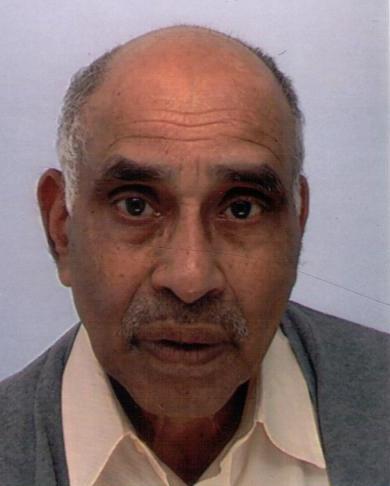
 This is a translation version of the original video documentary which was than transcribed and translated from Bengali to English. A book with the title of History of Bangladeshis in Greater Manchester has been published and it will be distributed to the libraries, schools and universities. The interview took place on 30th July 2009, so information about his personal family information may have been changed.
8.9 Bimal Kanti Battacharjee:
8.9.1 Life in Bangladesh:
In 1938, Bimal Kanti Battacharjee was born in the village of Daspara, Balagonj (Osmani Nagar), Sylhet. His father’s name is late Krishna Kumar Battacharjee. His father was a landlord, businessman and a religious teacher.
His primary education was completed at Lal Koilas Primary School; he then studied SSC at Mangalchandi High School up to Class 10. During his childhood he enjoyed playing football and Ha-do-do (Kapati) and had taken part in school sports activities. After the death of his father, he got involved with the family business. He was able to maintain his family expenses from the earnings of the business.
He inherited 90 Acres of Cultivation land and some property from his father. His grandfather also had huge amounts of land in the area of Gualabazar, Balagonj, Sylhet. His family life was very good. The village culture was very simple and traditional, people used to celebrate with each other. The majority of the villager’s occupations revolved around agriculture. The simple living of villagers meant that they weren’t interested in attaining wealth. Villagers would live in harmony and peace amongst each other.
8.9.2 Journey to the UK & Immigration:
In 1962, he came to Britain with a “Labour Voucher”. When he was a student he received information about life in Britain from the post office staff. The post office staff mentioned that labour vouchers were a route to gain access into Britain. He then collected a “Labour Voucher” form from the post office and he filled out the form and posted it to the British High Commission. After a few months, he received a letter from the High Commission. He obtained a Pakistani passport and went to Dhaka British High Commission where he got entry. He bought an airline ticket which cost around 1800 Rupees.
In 1962 he arrived in Heathrow Airport but before arrival, he imagined Britain would be a better country even though he never had any knowledge of the country. However, while he was in the aeroplane he felt very emotional as it would be a great distance between him and his family. He will be missing his loved ones in Bangladesh. He asked himself why he is leaving his home country and coming to Britain. On the same flight he had some friends who came to Britain.
8.9.3 Life in the UK:
During that time there wasn’t many shops. There was only one Bangladeshi grocery shop owned by Kolomdor Ali. They used to buy necessary grocery items from that shop. During that time, Bangladeshi families started to arrive and there were only 10 – 15 families who arrived in Hyde at that time. Sometimes, he used to get live chickens delivered to his home by English people. Sometimes, he used to go to Ashton-u-Lyne to do the grocery shopping.
There was not much entertainment as there were only a few cinemas and theatres. In the period of 1982 – 1983 the welfare association was established to help the community. There were regular monthly meetings organised by the Hyde Bangladesh Welfare Association to discuss any issues facing the Bangladeshi community and how the people can enjoy the prosperous life in the UK. In the past, it was difficult to find social time due to work. He used to work a 12 hour daily shift; if he had to work in the night shift then he used to sleep in day time and vice versa.
8.9.4 Employment:
Upon arrival to the UK, he and his friends went to visit a friend in East London. During his stay in London, he visited a Bangladeshi restaurant in Scunthorpe were he started work as a trainee waiter and his weekly wages were £5.00, free accommodation and food was provided by the employer. He worked there for two years; he used to make some savings and used to send money abroad to support his family. At that time the value of the pound was 20.00 Rupees.
He went to Stockport, Hyde and moved onto a Rubber Factory and worked as a trainee worker. He worked as a trainee for three weeks, during this time he stayed at this friend’s house but he had to support himself with food and a place to sleep. He was able to grip the English language quickly as he studied it back at home. At that time there were about 100 Bangladeshi people employed at the same factory.
He then moved to another factory and worked there for about a year and a half. Then he moved back again to his previous employer, there was an opportunity for many people, it was that they could leave the job and had gone abroad and upon their return they could re-employ with the same company but that opportunity was not available in the later stages.
He also worked at the Hyde CPA Company which was a cotton mill, where they used to print fabrics. He also worked at a cooker manufacturing company for some time. He worked at the factory for seven years; He then moved to another factory and worked there for 22 years. At the beginning his weekly wages were £50.00 and then his latest weekly wages were increased to £173.00 – £175.00.
He used make himself sandwiches for his lunch, no rice and curry were allowed at the beginning. When English people realised that rice and curry is the main food for the Bangladeshi, then it was allowed to be taken in the factory with Tiffin. There was some trouble; he had been attacked by the young stars, when he was coming from the factory with the wages. They tried to hijack the money and runaway.
8.9.5 Housing:
In 1966, he bought his own house for £500 which consisted of two bedrooms. Inside the house it didn’t have any bathrooms and toilet facilities. The toilet was located outside of the house and people used to have a shower in the public bath; he used to pay 2 shillings for using the facility. He only bathed once a week as it would be very time consuming due to the long queues.
The public bath was situated in the location of Hyde Library at Union Street. At that time there was no central heating system in the house. In order to heat the house coal would be used. The weekly expense for buying the coal was around three pounds. There was also no hot water. Sometimes the house was troubled and the police dealt with the matter efficiently.
In 1966, there were about six Bangladeshi houses, where all the single people used to live. There were families as such living in the area in the past.
After living at his first home for 12 years, he moved to Boardman Street in Hyde. This house was three bedrooms and he paid £7,000.00 to purchase the house. He installed the central heating system and a gas cooker to his new house. The bathroom and toilet was inside the house. In 1981, he bought a house on Church Street and paid £46,000.00. This house is consisting of three bedrooms and two reception rooms.
8.9.6 Social & Family:
He went to Bangladesh in 1970 and stayed there till 1973. During this period Bangladesh achieved independence. In 1973 he brought his wife with his two sons and one daughter to Britain. His oldest son was 16 years old and therefore got a job instead of being schooled. The second son went to school while the daughter was too young to join school.
During days off he used to go to other towns and watch films at the cinema. When he first arrived in the UK, there were very limited cinema halls. He said, “Very lately there was a theatre hall that was established on Corporation Street, Hyde”. He used to take his family to watch English & Hindi films at the cinema. There was no entertainment facility, at the Hyde Bangladesh Welfare Association. There was lack of video players at that time.
8.9.7 Independence of Bangladesh:
During the liberation period, he was living in Bangladesh (East Pakistan). During the war he was a witness of the events that unfolded. One day, he and his wife were coming from his in-law’s house, when they arrived at Sherpur; they were arrested by the Pakistani Military. Then an army member taken them to their camp office, fortunately, there was a family friend working at the camp office and was able to recognize them. Then his family friends offered some tea and breakfast and arranged a safe journey to Gualabazar, escorted by the Pakistani Army.
He heard the story from many Bangladeshis that an illiterate person would apply sign languages to understand the language which would be seen as funny. For example seeing the number 100 bus coming it would be known as a bus of one stick and two eggs.
8.9.8 Conclusion:
In his family life he is a father of two sons and two daughters. His eldest daughter is a social worker whilst the younger daughter is a solicitor. Both of his sons are involved in businesses. Overall he is a happy retired person who has made the most of life.